Thursday, 29 May 2025

The Laser Revolution Part II: Ground, Sea and Grid

The revolution continues! Warfare on the ground and sea will be heavily affected by megawatt-class lasers in the next two decades or so.

And, as we'll see, there are transformative applications in industry, energy generation, transportation and remote sensing.

Monday, 19 May 2025

The Laser Revolution Part I: Megawatt beams to the skies

There’s a laser revolution coming: a time when megawatt-scale beams will radically transform how we produce electricity, conduct war and even upset the nuclear world order. All they have to do it reach a certain convergence of price and power.

And by current projections, it will happen in the next two decades. 

Saturday, 9 December 2023

The Lofstrom Loop: A Bridge to Space

Imagine you could take a train ride to space. Tracks that slope up into the sky, higher and higher, until you reach a plateau above the planet where it’s a straight line up to orbital velocity.

That’s what’s possible with a Lofstrom Loop. But sending you into orbit is just one of the things it can do!

Friday, 26 May 2023

Riding Sunbeams with Solar Sails

Reset your expectations of solar sails. They are a fast and free way to travel to any point in the Solar System, as many times as you want, any time of the year.

Solar sails can carry passengers and they have a nearly unlimited number of uses. You just have to... think big!

Monday, 10 October 2022

Hypervelocity Tether Rockets

Rotating tethers can reach incredible velocities when they are built out of high strength materials. With some design features, they can greatly surpass the exhaust velocities of chemical or even nuclear rockets. They can become propulsion systems with impressive performance... and might look like the classic 'saucer' spaceship.

How would they work? What performance could they achieve?


Friday, 25 March 2022

Fusion without Fissiles: Superbombs and Wilderness Orion

Fusion technology today relies on expensive, building-sized equipment for ignition, or the help of an already powerful fission detonation. What if we could do away with both?

Fusion power without the need for fissiles, but also small enough to be launched into space. It is possible, and eventually it will be practical. Let’s look at how that would work and its implications. 

Thursday, 14 October 2021

Nuclear Conversion for Starship

There has been much discussion about converting the SpaceX Starship to use nuclear propulsion. It would allow for a great increase in specific impulse and a massive extension of mission capabilities.

But is it actually worthwhile?

Thursday, 11 March 2021

Fusion Highways in Space

A transport system that can get spacecraft to Jupiter in 10 days, but without a massive onboard reactor, using antimatter fuel or riding a gigantic laser beam? 

What we need instead is a Fusion Highway to connect the Solar System in unprecedented ways. 

Monday, 4 January 2021

Moto-Orion: Mechanized Nuclear Pulse Propulsion

The Orion nuclear pulse propulsion concept has been around for over six decades now. It is powerful and robust, but lacks the flexibility and features we expect from many more modern designs.

Can we give it those additional capabilities?

Monday, 16 November 2020

Nuclear Photon Rockets: Flashlights to the Stars

In this post, we will have a look at the concept of using a nuclear photon rocket for interstellar travel. They are an old concept that should theoretically be the ultimate form of relativistic propulsion.
However, today they are unknown or unpopular. Why might that be the case?

Tuesday, 15 September 2020

Space Tethers: Stringing up the Solar System

All the methods we have used to reach space so far have been subject to the Tsiolkovsky rocket equation - propellant must be ejected and more and more of it is needed to go further.

What if we could break that equation with rotating orbital tethers?

Wednesday, 27 November 2019

Hypervelocity Macron Accelerators

We look at the various ways of accelerating micro-scale projectiles up to hypervelocity (10-10,000 km/s) and their use in space.

Saturday, 5 October 2019

The Expanse's Epstein Drive

We aim to take a fictional propulsion technology from The Expanse, and apply the appropriate science to explain its features in a realistic manner.
This also applies to other SciFi settings that want a similar engine for their own spacecraft.

Friday, 27 September 2019

NTER: Nuclear Thermal-Electric Rocket

There is a type of nuclear propulsion that can have most of the acceleration of a nuclear thermal rocket but also the high Isp of an electric thruster. 
Let’s have a look at nuclear ‘thermal-electric’ engines and their advantages.

Thursday, 22 August 2019

How to Live on Other Planets: Uranus

The weirdest of the planets. A blue giant, resting on its side.
Could we find a home in the Uranian system?

Friday, 7 June 2019

Thermal Decomposition of CO2 with Nuclear Heat

A lot of effort must and will be put into combating climate change. We can however directly attack the root cause of it by reducing the amount of CO2 that we have released into the atmosphere.
We can enlist the help of ultra-high-temperature nuclear reactors to do this rapidly and efficiently.

Sunday, 26 May 2019

Starship Lite: from rapid Interplanetary to Interstellar

Elon Musk stated that a stripped-down SpaceX Starship could become an interplanetary boost vehicle able to push probes towards the farthest objects in our Solar System. 

What other missions could the Starship ‘Lite’ do, and how quickly?

Sunday, 12 May 2019

Actively Cooled Armor: from Helium to Liquid Tin.

We have seen designs for long ranged particle beams and powerful lasers. Could they be the end-all, be-all of space warfare? Not if we fend off their destructive power with actively cooled armor.
Let's have a look at the different cooling solutions, from high pressure gas to liquid metal, and evaluate their relative effectiveness.

Saturday, 20 April 2019

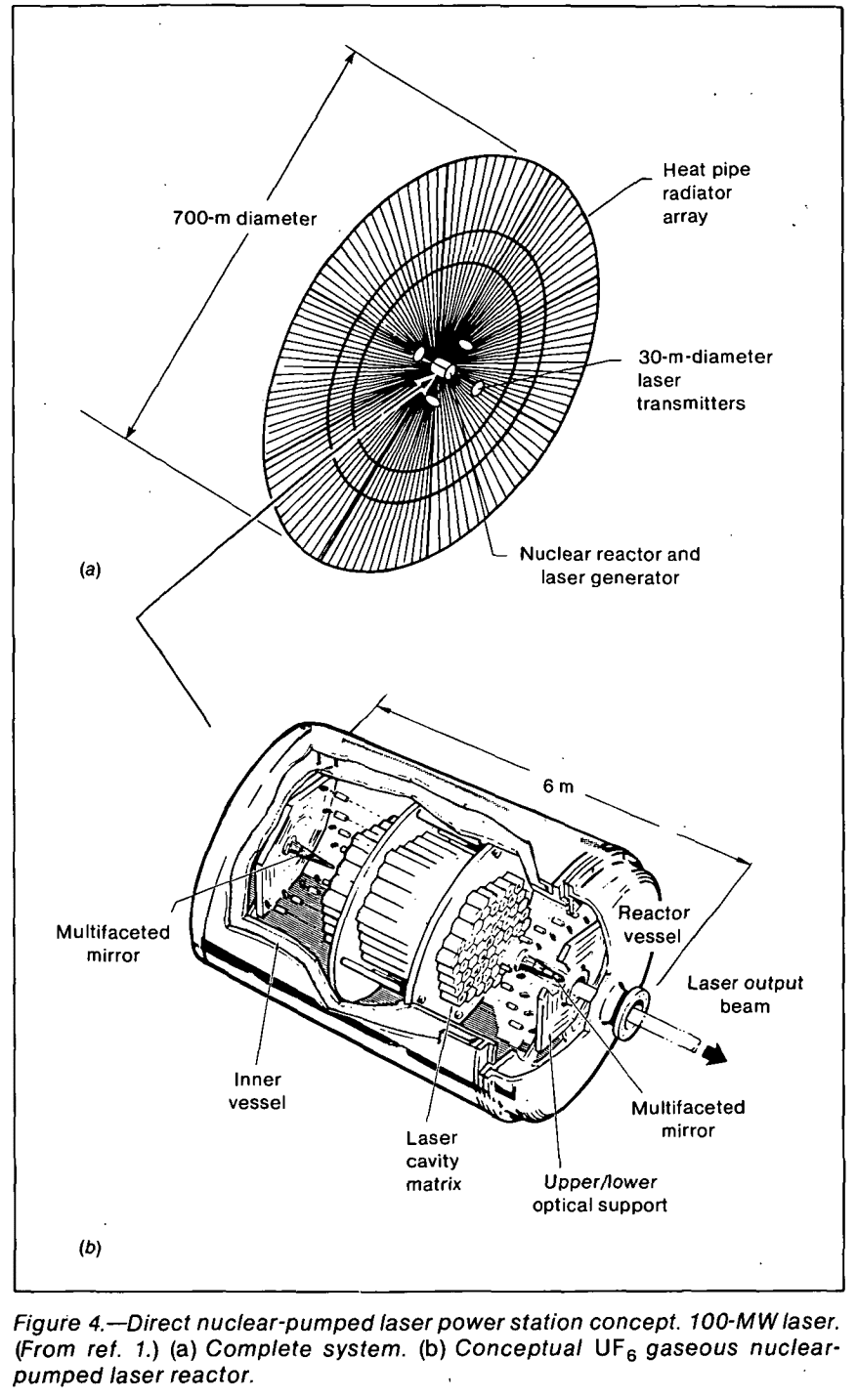
Nuclear Reactor Lasers: from Fission to Photon

Nuclear reactor lasers are devices that can generate lasers from nuclear energy with little to no intermediate conversion steps. 
We work out just how effective they can be, and how they stack up against conventional electrically-powered lasers. You might want to re-think your space warfare and power beaming after this. 

Monday, 18 February 2019

Cold, Laser-Coupled Particle Beams

This is a follow-up to the Particle Beams in Space post.

This time, we look at two concepts that can massively increase the effective range of particle beam: one is being applied every day in modern accelerators, and the other is an outgrowth of a tool used in biophysics.